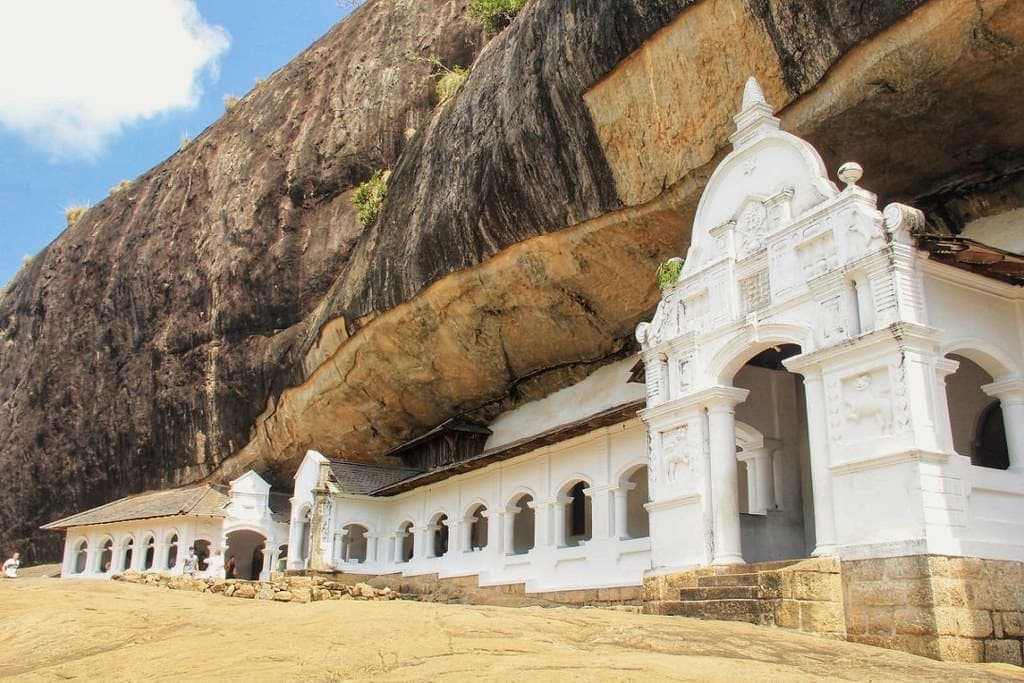
A royal citadel built on top of a 200-metre column of rock, abandoned for centuries and swallowed by jungle until the nineteenth century. The most extraordinary thing you will climb in Sri Lanka, and half an hour from your room.
In the fifth century King Kasyapa moved his capital to the top of a granite monolith rising straight out of the plain. What he built there — water gardens, terraced approaches, frescoed galleries and a palace on the summit — was abandoned within two decades of his death and lost to forest until British surveyors came across it again.
The climb begins gently, through symmetrical water gardens that still fill during the rains, then steepens into staircases cut against the rock face. Halfway up, a sheltered gallery holds the frescoes: a group of women painted in ochre and red, still vivid after fifteen hundred years. Beyond them runs the Mirror Wall, once polished to a shine and now covered in graffiti left by visitors between the eighth and tenth centuries — among the oldest surviving Sinhalese verse.
The final stretch passes between two enormous carved lion's paws, all that remains of a gateway that once framed the head of a lion. From the summit the plain opens out in every direction: tank, forest, and the blunt shape of Pidurangala just to the north.
It is roughly 1,200 steps to the top on metal staircases bolted to the rock. Anyone reasonably steady on their feet manages it, but there is no shade up there, which is why the hour you choose matters more than anything else.